North Dakotans are in an enviable position in 2026. The state is well on the way to protecting nearly half the state’s population from the effects of drought.
A Much-Needed Drought Project
“I give a lot of credit to the State of North Dakota for recognizing the importance of implementing a long-term solution to protect central and eastern North Dakota from the devastating effects of future droughts,” says Duane DeKrey, Garrison Diversion Conservancy District (Garrison Diversion) General Manager. Garrison Diversion is a co-sponsor of the Red River Valley Water Supply Project (RRVWSP) along with the Lake Agassiz Water Authority. “The estimated financial impact of a drought similar to the 1930s Dust Bowl is $33 billion over 10 years. That would impact the entire state’s economy.”
“The state has been an excellent partner in this drought mitigation project,” says Merri Mooridian, Deputy Program Manager of RRVWSP Administration and Garrison Diversion Administrative Officer. “Thanks to support from Sen. John Hoeven and Sen. Kevin Cramer, the federal government has also stepped up with $150 million for the Eastern North Dakota Alternate Water Supply, a project that complements the RRVWSP by using existing Bureau of Reclamation infrastructure.”
The RRVWSP will provide an emergency and supplemental water supply to communities and rural water systems in central and eastern North Dakota by conveying water from the Missouri River via a 125-mile buried pipeline. When construction wraps up, nearly half of the state’s population will benefit from the additional water supply.
The RRVWSP has been in the works since the year 2000, when it was conceived as a federal, state and local project. However, without federal authorization, a state and local version of the project was developed due to the dire need for water resiliency. Construction began in 2021 thanks to support from the North Dakota State Water Commission (now called the Department of Water Resources). The project is anticipated to be complete by 2032.
“It will be a relief when the construction wraps up, and communities and rural water systems receive water from the Red River Valley Water Supply Project. This is a historic project, one that I’m certainly proud to have worked on during my career at Garrison Diversion,” says Kip Kovar, Deputy Program Manager for RRVWSP Engineering and Garrison Diversion Engineer.
Drought Conditions Across the U.S.
Having a project like the RRVWSP in place to protect North Dakota’s residents and economy is a true blessing when one considers what other states are facing. More than half of the United States experienced drought conditions during the spring of 2026.
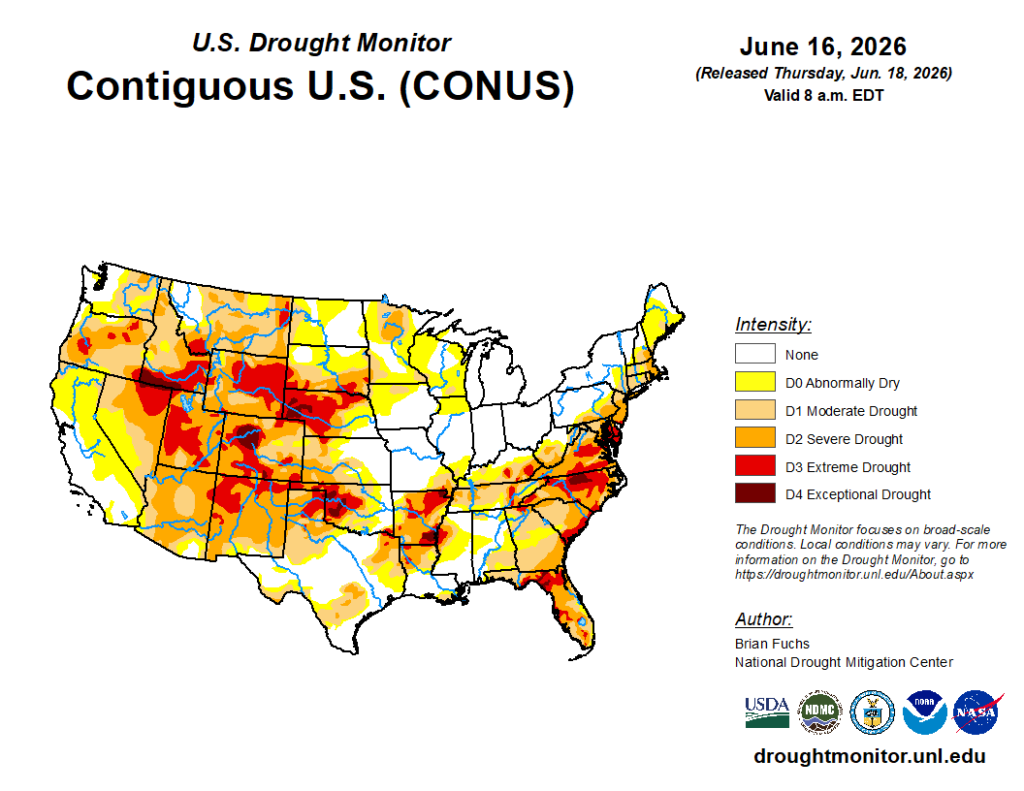
More than 97% of Colorado is in a drought, with 79% of the state in the severe, extreme, or exceptional category. Some of the lowest recorded winter snowpack levels, combined with little rain and higher-than-normal spring temperatures, created a statewide emergency. In an effort to cut water use by 20%, the City of Denver issued watering restrictions along with a rule requiring restaurants to serve tap water to customers only on request, instead of automatically providing it to guests.
North Dakota’s neighboring states are also experiencing drought, though not to the same degree as Colorado. More than 76% of Montana, nearly 55% of South Dakota, and more than 37% of Minnesota are seeing drought conditions as of June 16. But what about us? The U.S. Drought Monitor listed North Dakota and Michigan as the only two drought-free states in late April. By mid-June, drought conditions crept into 10.3% of North Dakota.
North Dakota is no stranger to dry spells. In fact, drought is an unfortunately common occurrence. Historic droughts during the 1930s Dust Bowl and 1950s affected our water supplies and agriculture. Many people remember the more recent drought of the 1980s and the short but intense droughts of 2012, 2017, 2020, and 2021.
North Dakota’s Highly Variable Climate
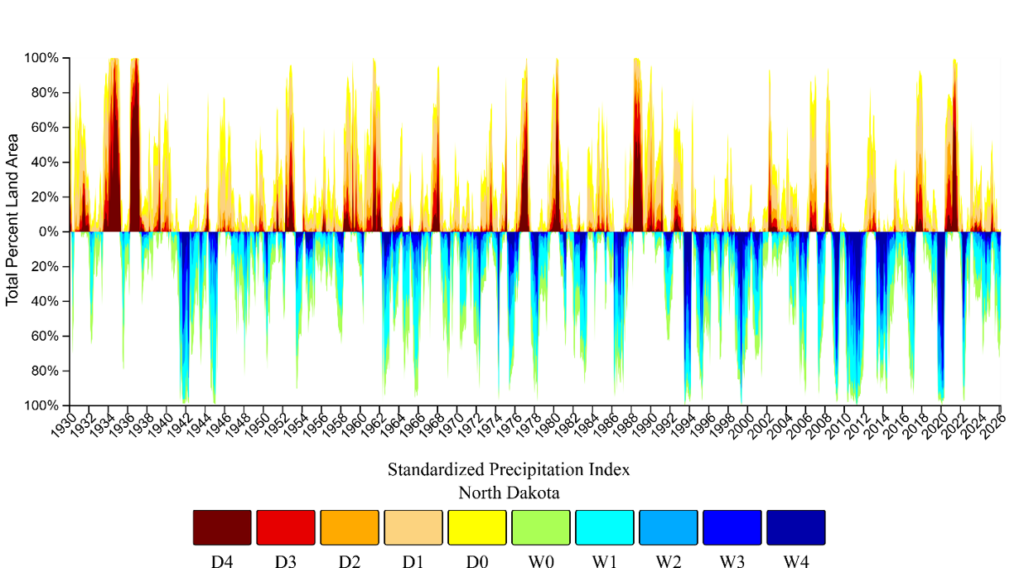
North Dakota’s climate is highly variable, with the potential for droughts and floods occurring during back-to-back years. In 2011, several areas of the state experienced serious flooding, including Fargo and Minot. Even climatologists were surprised by the summer drought that followed in 2012.
In the chart below, the dark red areas indicate extremely dry conditions while the dark blue shows extremely wet periods. This illustration makes it easy to see how North Dakota continuously seesawed between wet and dry periods from 1930 through 2026.
“Our constant back and forth between too much and too little water highlights the importance of being prepared, which the State of North Dakota has helped its residents achieve by supporting drought and flood projects across the state,” says DeKrey. “We should all be thankful to our state and federal delegation for supporting projects like the Red River Valley Water Supply Project. We’re miles ahead of a lot of other states right now in terms of drought mitigation efforts.”
Hopefully, North Dakota will avoid worsening drought for the rest of 2026. Though construction is underway and making steady progress, we are still a few years from being able to rely on the RRVWSP for an emergency and supplemental water supply.